
Car Engine Water Pump
Basic Structure
Structure Type
According to different supporting requirements and working conditions, automotive mechanical water pumps can be divided into several types such as reciprocating water pumps, centrifugal water pumps and spiral water pumps. Due to the limitation of space size, a centrifugal water pump consisting of a water inlet chamber, an impeller and a water outlet chamber is usually used. This structure has the characteristics of small size, light weight, large water supply, simple structure, etc., and is the most widely used structure type.

Structural Design
There are many parts around the automobile cooling water pump, and its structural design must comply with the overall layout requirements of the engine, so that the flow path of the water pump in and out, the shape and section of the volute chamber, the layout of the water pump inlet and outlet, the impeller inlet structure and the basic size are determined etc. are often difficult to meet normal hydraulic design requirements, thus directly affecting the improvement of operating performance including efficiency.
The structure of the water inlet chamber of the automobile cooling water pump is divided into straight cylinder type or spiral shape, and the structure of the water outlet chamber is spiral shape and is integrated with the engine casting. The structural geometric parameters of the impeller have a decisive influence on the operating performance of the water pump. Automobile cooling water pumps generally adopt a semi-open impeller structure without a front cover.
Working Principle
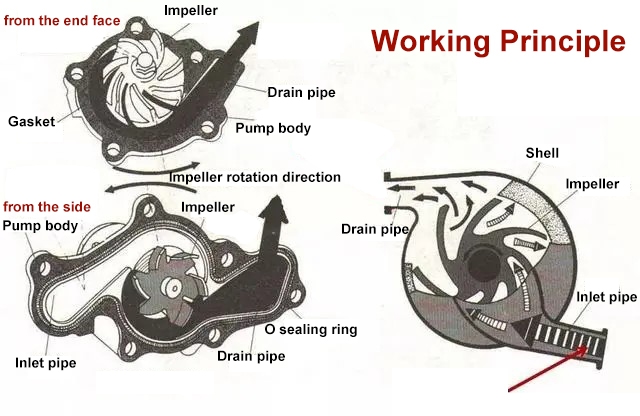
The engine drives the water pump bearing and impeller to rotate through the pulley.
The coolant in the water pump is driven by the impeller to rotate together. Under the action of centrifugal force, it is thrown to the edge of the water pump casing. At the same time, a certain pressure is generated, and then flows out from the water outlet or water pipe.
The pressure at the center of the impeller is reduced because the coolant is thrown out. The coolant in the radiator is sucked into the impeller through the water pipe under the pressure difference between the water pump inlet and the center of the impeller, realizing a reciprocating circulation of the coolant.
Basic Composition
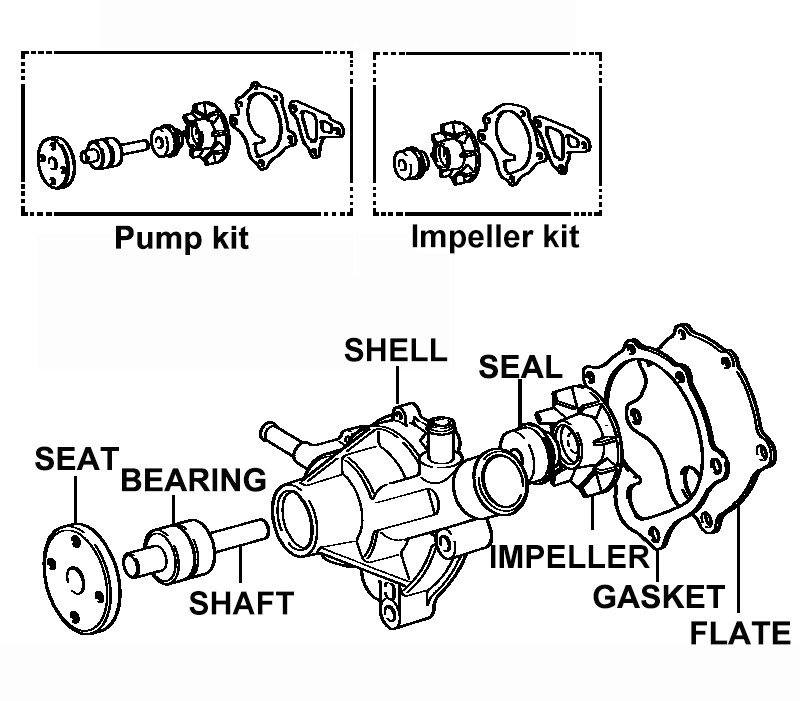
 Shell: It is connected to the engine cylinder block through seals and supports moving parts such as bearings.
- Impeller: It is composed of centripetal radial linear or arc-shaped blades. It uses the rotational torque transmitted from the bearing shaft to pump the coolant into the engine cooling system for circulation.
- Bearing: Support the impeller and water pump shaft so that they can run smoothly when rotating at high speeds.
- Seal: Located at the connection between the water pump housing and the engine, it prevents coolant leakage and ensures the normal operation of the water pump.
- Shaft: The component that connects the impeller to the water pump drive system, usually made of strong metal to withstand the rotational forces of the impeller.
- Drive System: Typically driven by the engine crankshaft or belt, allowing the water pump to rotate and pump coolant.
 Shell: It is connected to the engine cylinder block through seals and supports moving parts such as bearings.
Function
- Cool the engine: The main function of a car engine water pump is to circulate coolant (usually a mixture of water and antifreeze) to reduce the temperature of the engine. The water pump ensures that the engine operates within its normal operating temperature range by drawing coolant from the water jacket around the engine and pushing it to the radiator.
- Protect the engine: Maintaining a suitable operating temperature is crucial for car engines. The water pump absorbs and dissipates the heat generated by the engine by circulating coolant, effectively protecting the engine from overheating and extending its service life.
- Optimize fuel efficiency: Keeping the engine within a suitable operating temperature range can improve fuel combustion efficiency, thereby improving the vehicle’s fuel economy. The normal operation of the water pump helps optimize the engine’s combustion process and reduce fuel consumption.
- Stabilize engine performance: Engine temperature that is too high or too low will affect its performance and stability. The function of the water pump is to maintain the engine running within a suitable temperature range, ensure stable engine performance, and improve the reliability and safety of the car.
- Reduce emissions: Running the engine at a suitable temperature can more effectively control exhaust emissions and reduce environmental pollution. The cooling effect of the water pump helps keep the engine running at optimal operating temperature, thereby reducing harmful emissions.