
The Difference Between Electric And Mechanical Water Pump For Car Engine
The automobile water pump is an important component in the engine cooling system. It usually consists of a pump body, impeller, bearings, sealing rings and other components.
Among them, the pump body is the main structure of the water pump, the impeller is responsible for driving the flow of coolant, the bearing is used to support the water pump rotor and prevent vibration, and the sealing ring is used to prevent the water pump from leaking.
Different types of automobile water pumps have different structures and working principles due to their different usage scenarios and characteristics, such as mechanical water pumps and electric water pumps.
Mechanical water pump
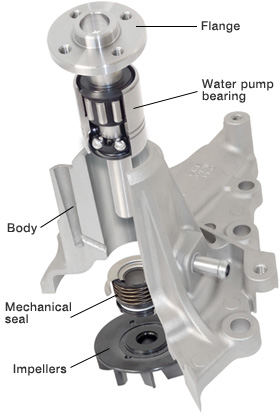
Basic structure of mechanical water pump
A mechanical water pump usually consists of a mechanical impeller and a belt or chain driven by the engine crankshaft to achieve the rotation of the water pump.
The structure of the automobile engine mechanical water pump mainly includes the pump body, impeller, bearings, sealing rings, water seals and other parts. The pump body is the main structure of the water pump and is used to contain the coolant; the impeller is connected to the engine through a bearing and rotates with the engine to suck the coolant into the pump body from the water inlet pipe; the sealing ring and water seal are used to prevent coolant leakage; the water outlet is Send the coolant pressurized by the pump body to the radiator.
Working principle of mechanical water pump
The operation of the mechanical water pump relies on the mechanical power of the engine, usually driven by the crankshaft.
The engine drives the water pump bearing and impeller to rotate through the pulley. The coolant in the water pump is driven by the impeller to rotate together. Under the action of centrifugal force, it is thrown to the edge of the water pump casing. At the same time, a certain pressure is generated, and then flows out from the water outlet or water pipe. The pressure at the center of the impeller is reduced because the coolant is thrown out. The coolant in the water tank is sucked into the impeller through the water pipe under the pressure difference between the water pump inlet and the center of the impeller, realizing a reciprocating circulation of the coolant.
Features of mechanical water pump
- It has simple structure and high reliability.
- Lower cost, easy to maintain and replace.
- Suitable for traditional automotive engine cooling systems, commonly found in internal combustion engine vehicles.
- Relying on engine drive, the power comes directly from the engine, so the starting performance is better.
- When the engine is running, the water pump will also run, but the speed will not change much, so the flow rate and pressure will be relatively stable.
Electronic water pump
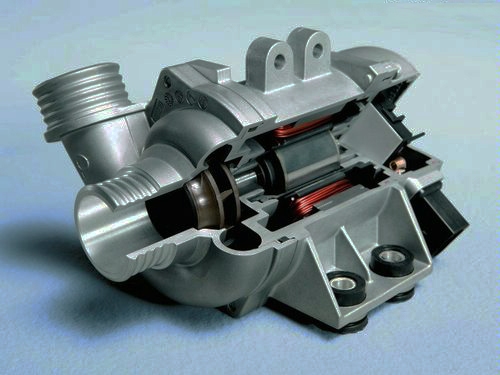
Basic structure of electronic water pump
Electronic water pumps use an electronic control system to drive the water pump, usually consisting of an electronic control unit (ECU) and an electronic driver.
The automotive electronic water pump is a pump that uses an electronically controlled drive unit, which is mainly composed of an overcurrent unit, a motor unit and an electronic control unit. According to different application requirements, there are different types of electronic water pumps, such as brushless DC centrifugal water pumps, electromagnetic drive water pumps, etc. The structure of an electronic water pump usually includes a motor, impeller, pump casing, water seal and other parts.
Working principle of electronic water pump
The operation of the electronic water pump does not rely on the mechanical power of the engine, but controls the operating status of the water pump through an electronic control system. The electronic control unit monitors parameters such as engine temperature and controls the speed and output of the water pump through an electronic driver.
The working principle of the electronic water pump is to adjust the working status of the water pump through the electronic control unit, such as start/stop, flow control, pressure control, etc. Under cold start and high-load conditions, the electronic water pump can accurately control the flow of coolant according to the actual needs of the engine, thereby improving cooling efficiency and reducing energy consumption. At the same time, the electronic water pump also has functions such as anti-dry running protection and self-maintenance, which can extend the service life of the water pump.
Features of electronic water pump
- Compact structure, easy installation and flexible control.
- No mechanical connection is required, which reduces energy loss and improves efficiency.
- The operating status of the water pump can be adjusted as needed, with high flexibility.
- It is suitable for some automobile engine cooling systems that require intelligent control, and is commonly found in high-end vehicles such as new electric vehicles.
- Providing precise control when needed, such as during cold starts and high load conditions, the electronic water pump can precisely control the flow of coolant based on the actual needs of the engine.
- It has functions such as anti-dry running protection and self-maintenance, which can extend the service life of the water pump.
Current status and prospects of car engine water pump
The mechanical water pump has a simple structure, high reliability, low cost, and easy maintenance, and can meet the needs of most automobile engine cooling systems.
The power of the mechanical water pump comes directly from the engine, and the starting performance is good. When the engine is running, the water pump will also run with the flow and pressure are relatively stable.
However, with the continuous development of automobile technology and the increasing requirements for engine cooling systems, the application of electronic water pumps is becoming more and more widespread. The electronic water pump has the advantages of compact structure, flexible control, reliable performance, low power consumption, and high efficiency. It can meet some specific needs, such as accurately controlling the coolant flow, improving cooling efficiency, and extending the service life of the water pump.