
Auto CV Joint Drive Shaft Assembly Guide
Inner CV Joint + Drive Shaft + Outer CV Joint
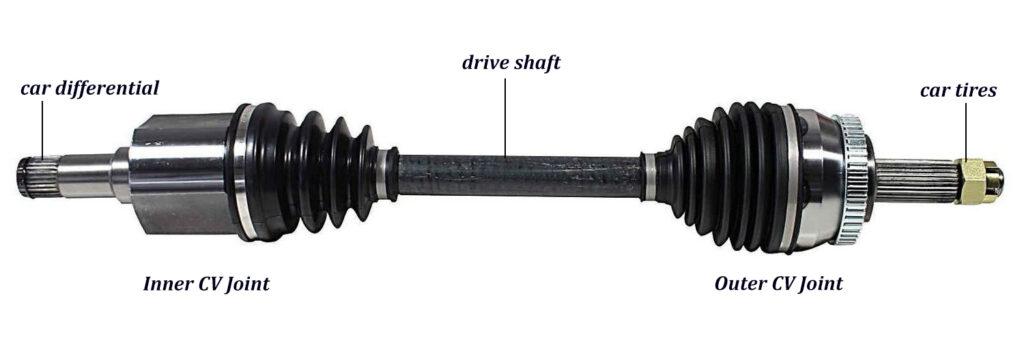
Drive shaft:
The drive shaft is an important part that connects the outer CV Joint and the inner CV Joint. It is responsible for transmitting power from the transmission to the wheels. Drive shafts are usually made of high-strength, high-precision steel and undergo precision machining and heat treatment to ensure they can withstand high loads and high-speed rotations. The design of the drive shaft needs to take into account the vehicle’s driving conditions, such as turning radius, driving speed, etc., to ensure constant speed and smoothness of power transmission. In addition, the drive shaft also needs to have sufficient rigidity and toughness to withstand various shocks and vibrations generated during vehicle driving.
CV Joint
CV Joint is the abbreviation of “Ball-Cage Type Constant Velocity Joint”. The automobile CV Joint is divided into an inner CV Joint and an outer CV Joint. It is an important component in the car transmission system. Its function is to transmit the engine power from the transmission to the two front wheels and drive the car to travel at high speed. Because the constant velocity universal joint transmits heavy driving torque, is subject to heavy loads, has high transmission accuracy, is in great demand, and is a safety part, its main parts are all made of precision forgings.
Outer CV Joint:
Fixed CV Joint (RF joint), the outer CV Joint is connected to the wheel.
Whether it is power output or when the vehicle is turning, the outer CV Joint is at work.

The composition of the outer CV Joint:
Bell shell outer race
Star wheel inner race
cage
steel ball
Dust cover
beam ring
grease
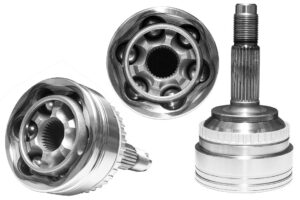
The steel balls of the outer CV Joint are fixedly placed in the six windows of a cage between the inner race and the outer race. The steel balls have exactly half positions in the inner race and outer rac, so as to determine the universal direction. The angle of action of the knot. The steel balls are fixedly placed in the cage, and each steel ball pushes the fairway in its respective inner race and outer race, transmitting torque through the steel balls instead of the teeth of the gear. This structure allows the outer CV Joint to only transmit torque in all directions without slipping.
Inner CV Joint:
Telescopic CV Joint (VL joint). The Inner CV Joint is connected to the gearbox differential.
The design of the Inner CV Joint allows it to expand and contract within a certain range to accommodate changes in driveline length as the vehicle travels.

The composition of the inner CV Joint:
Bell shell outer race
Tripod bearings or steel balls (the main difference is here)
Dust cover
beam ring
grease
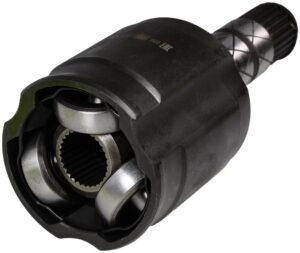
Inner CV Joint (tripod type):
There are no steel balls in the tripod universal joint. Instead, it uses three bearings with needle rollers, which can be carried out in three tracks in the bell shell outer race. slip. It is mainly used for the inner CV Joint of four-wheel drive vehicles. It is suitable for the position of the inner CV Joint with a small torsion angle. It can slide inward and outward to adapt to the length change of the drive shaft when the vehicle moves.
Inner CV Joint (six-bead type):
The six-bead internal CV Joint is a sliding type constant velocity universal joint product, mainly used in the transmission system of four-wheel drive vehicles. The design of this internal CV Joint features six steel balls inside that transmit torque within an inclined track. The performance of the product is excellent, surpassing the TJ-type inner CV Joint, but the sliding distance is shorter, which can solve the noise problem, and is widely used on four-wheel drive vehicles.