
Automotive Engine Water Pump Guide
The water pump is an important component of the engine cooling system. Its function is to pump the coolant so that the coolant flows quickly in the cooling water channel of the engine to take away the heat generated when the engine is working and maintain the normal operating temperature of the engine.
The transmission mode of car water pump
How a car’s water pump is driven usually depends on the type and design of the engine, as well as the vehicle manufacturer’s preferences. The following are several common car water pump transmission methods:
Belt drive:
This is one of the most common water pump transmission methods, especially in traditional internal combustion engines.
The crankshaft of the engine drives a belt, which in turn turns the shaft of the water pump to make the water pump work.
Belts are usually made of rubber and need to be replaced regularly to ensure they are in good working order.
Chain drive:
Some cars use a chain to drive the water pump, especially high-performance engines or some diesel engines.
Chains are more durable than belts, but they also require regular inspection and maintenance.
Gear drive:
In some cars and diesel engines, the water pump can be driven through the engine’s gear system.
This type of transmission is generally more durable, but also more complex and expensive.
Electric water pump:
Some modern cars are equipped with an electric water pump, which does not rely on the engine’s transmission system but is driven by an electric motor.
An electric water pump is typically powered by the vehicle’s electrical system and can be precisely controlled as needed to improve fuel efficiency and engine performance.
Other transmission methods:
In some special applications, such as some hybrid or electric vehicles, the water pump transmission method may be different, and hydraulic transmission or other innovative technologies may be used.
The basic components of car water pump
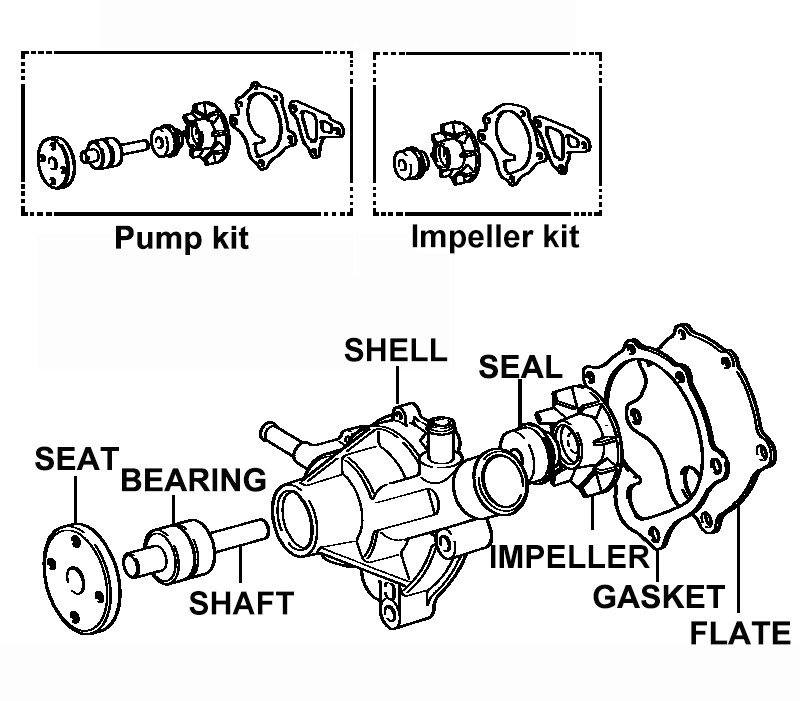
The automobile engine water pump is a key component in the engine cooling system. Its structure usually includes the following main components:
Pulley: Transmits the power from the transmission belt to the water pump bearing shaft, thereby driving the impeller to rotate.
Pump housing: The water pump housing, usually made of aluminum alloy or cast iron, is used to house the internal components of the water pump and connect it to the engine.
Impeller: The impeller is one of the most important components in the water pump. It is usually made of metal and its shape is designed to generate negative pressure through rotation, sucking coolant from the engine water jacket and circulating it through the cooling system.
Water pump bearings: Water pump bearings support the impeller and water pump shaft so that they can maintain smooth operation during high-speed rotation.
Water pump seal: The water pump seal is located at the connection between the water pump housing and the engine to prevent coolant leakage and ensure the normal operation of the water pump.
Water pump shaft: The component that connects the impeller and the water pump drive system. It is usually made of strong metal to withstand the rotational force of the impeller.
Water pump drive system: Usually driven by the engine crankshaft or belt, allowing the water pump to rotate and pump coolant.
The above are the basic structural components of a car engine water pump. The design and structure of the water pump may vary depending on the car model and manufacturer, but its basic principle and function remain the same, which is to control the engine temperature by circulating coolant to ensure that the engine remains within the appropriate operating temperature range when running.
The basic structure of car water pump
structural design
The automobile cooling water pump is the heart of the automobile engine cooling system. Its function is to increase the working pressure of the coolant in the circulation system, maintain the coolant circulation between related engine components, and prevent the engine operating temperature from being too high. Depending on the supporting requirements and working conditions, the structural types of automobile cooling water pumps include centrifugal pumps, vortex pumps, and rotary positive displacement pumps. Due to limitations in space size, single-stage centrifugal pumps composed of a water inlet chamber, an impeller, and a water outlet chamber are usually used. This structure has the characteristics of small size, light weight, large water supply, and simple structure. It is the most widely used structural type. A typical centrifugal cooling circulating water pump mainly consists of a pump body, an impeller, a bearing, a water seal and a pulley.
There are many parts around the automobile cooling water pump, and its structural design must comply with the overall layout requirements of the engine, so that the flow path of the water pump in and out, the shape and section of the volute chamber, the layout of the water pump inlet and outlet, the impeller inlet structure and the basic size are determined etc. are often difficult to meet normal hydraulic design requirements, thus directly affecting the improvement of operating performance including efficiency. The structure of the water inlet chamber of the automobile cooling water pump is divided into straight cylinder type or spiral shape, and the structure of the water outlet chamber is spiral shape and is integrated with the engine casting. The structural geometric parameters of the impeller have a decisive influence on the operating performance of the water pump. Automobile cooling water pumps generally adopt a semi-open impeller structure without a front cover.
impeller

The main categories of car engine water pump impellers are as follows:
According to the blade form, there are three types: open impeller, closed impeller and semi-open impeller. Among them, the closed impeller is composed of front and rear cover plates and blades; the semi-open impeller is composed of blades and back cover plate; the open impeller has only blades and part of the back cover plate, or no back cover plate.
According to the structure, there are four types: channel type (single channel, double channel), blade type (closed type, open type), spiral centrifugal type, and vortex type. Among them, the flow channel impeller has a curved flow channel from the inlet to the outlet. This type of impeller is suitable for transporting liquids containing large particle impurities or long fibers, but its anti-cavitation performance is weaker than other forms.
According to the material, it includes cast iron impeller, aluminum alloy impeller, brass impeller, stainless steel impeller and plastic impeller.
Different types of impellers are suitable for different working scenarios and needs, so various factors need to be considered when selecting a suitable impeller.
Inlet and outlet chambers
The water inlet chamber and outlet chamber of the automobile engine water pump are its important components. Their main functions are as follows:
Inlet Chamber:
The inlet chamber is an area of the water pump located on one side of the water pump housing, usually near the engine’s coolant jacket. The main function of the water inlet chamber is to suck coolant from the coolant water jacket and transfer it to the impeller of the water pump.
- Introducing coolant: The coolant enters the water pump through the water inlet chamber to provide a coolant source for the water pump.
- Fixed impeller: The water inlet chamber is the installation location of the water pump impeller. The impeller is fixed on the shaft through the water inlet chamber and ensures its stable operation.
- Shock absorption and sealing: The water inlet chamber also plays the role of shock absorption and sealing, reducing vibration when the water pump is running and preventing coolant leakage.
Outlet chamber:
The outlet chamber is another area of the water pump, located on the other side of the water pump housing, usually near the engine’s coolant circulation pipe or radiator. The main function of the water outlet chamber is to receive the coolant rotated in the impeller, discharge it from the water pump, and send it to the engine’s coolant circulation system, or directly into the radiator for cooling.
- Delivering coolant: The water outlet chamber is responsible for delivering the coolant in the water pump to the engine’s cooling system to maintain the normal operating temperature of the engine.
- Connect the water pipe: The water outlet chamber is connected to the engine’s radiator and other components through water pipes to ensure that the coolant circulates in the correct path.
- Support and fixation: The water outlet chamber also plays the role of supporting and fixing the water pump, so that the water pump can be stably installed on the engine.
Water inlet method
Car engine water pumps usually have two water inlet methods, namely end face water inlet and side face water inlet.
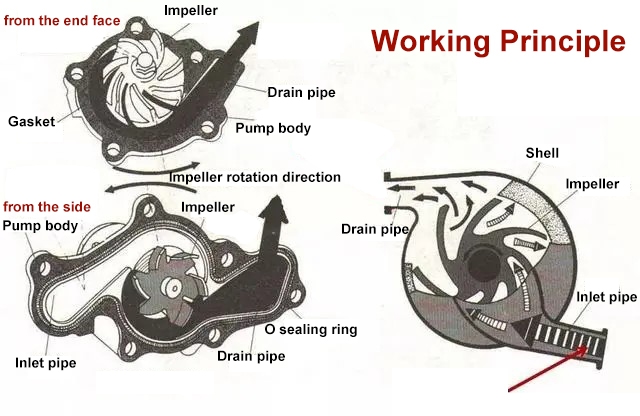
End face water ingress:
In the end-face water pump design, the water inlet of the water pump is located on the end face of the water pump, that is, the front of the water pump. When the water pump starts to work, due to the cooperation of the centrifugal force of the blades and the mechanical angle of the blades, water is drawn into the water pump and pushed to the water outlet of the water pump through the movement of the blades, which is the drain outlet. This process creates pressurization and provides pressurized water, which is used to provide the required pressure to the entire system.
Side face water ingress:
In a side-feed water pump design, the water inlet of the water pump is located on the side of the pump. Different from the end face water inlet, the side water inlet impeller rotation direction is also counterclockwise, but the water is thrown into the exhaust duct through centrifugal force. Although the impellers of the two modes rotate in the same direction, the angles of the entire blades are opposite. In the design of side water inlet, the pumping of water completely relies on the water driven by the impeller and the centrifugal force generated by the mechanism angle of the blade to pump water.
These two water inlet methods have their own advantages and application scenarios in the design of automobile engine water pumps. Based on actual needs and system design, choosing the appropriate water inlet method can more effectively meet the working requirements of the water pump.
How does a car water pump work?
1. Working principle
A centrifugal pump is a pump that uses centrifugal force generated by the rotation of an impeller to transport liquids. The basic structure includes pump casing, impeller, sealing ring, bearings and motor. When the motor drives the impeller to rotate, the water in the impeller flows along the pump casing toward the outlet under the action of centrifugal force, forming a negative pressure. As a result, the fluid is sucked in and discharged.
2. Impeller rotation
The impeller is the core part of a centrifugal pump and is usually designed in a twisted arc shape so that water can gain sufficient speed and kinetic energy after entering the impeller. The impeller is driven to rotate by a motor, generating centrifugal force.
3. Fluid suction and discharge
During the rotation of the impeller, a negative pressure is formed in the pump, causing the fluid to be sucked into the pump. As the impeller rotates. The fluid acquires kinetic and pressure energy and is eventually discharged from the outlet of the pump. The suction and discharge process of fluid is continuous, realizing continuous delivery of liquid.
The function of car water pump
1. Cool the engine:
The main function of a car engine water pump is to circulate coolant (usually a mixture of water and antifreeze) to reduce the temperature of the engine. The water pump ensures that the engine operates within its normal operating temperature range by drawing coolant from the water jacket around the engine and pushing it to the radiator.
2. Protect the engine:
Maintaining a suitable operating temperature is crucial for car engines. The water pump absorbs and dissipates the heat generated by the engine by circulating coolant, effectively protecting the engine from overheating and extending its service life.
3. Optimize fuel efficiency:
Keeping the engine within a suitable operating temperature range can improve fuel combustion efficiency, thereby improving the vehicle’s fuel economy. The normal operation of the water pump helps optimize the engine’s combustion process and reduce fuel consumption.
4. Stabilize engine performance:
Engine temperature that is too high or too low will affect its performance and stability. The function of the water pump is to maintain the engine running within a suitable temperature range, ensure stable engine performance, and improve the reliability and safety of the car.
5. Reduce emissions:
Running the engine at a suitable temperature can more effectively control exhaust emissions and reduce environmental pollution. The cooling effect of the water pump helps keep the engine running at optimal operating temperature, thereby reducing harmful emissions.